
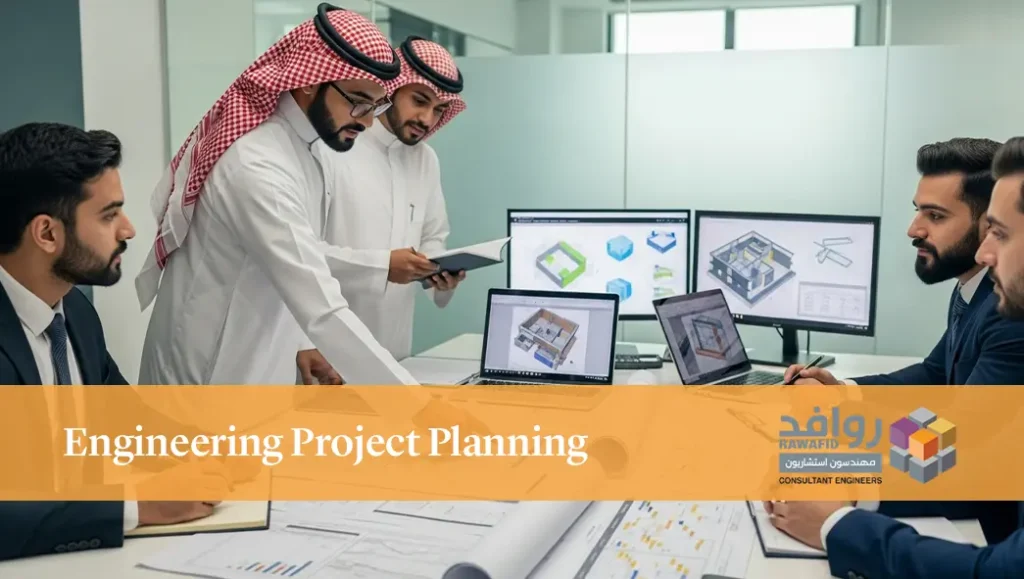
How Engineering Project Planning Protects Your Investment and Ensures Success
In reality, many projects in Saudi Arabia face delays, exceed budgets, or encounter other issues due to poorly considered decisions in the pre-design phase, where planning is often underestimated or treated as a formal procedure.
Here lies the true value of engineering project planning: it is not just an administrative stage but a strategic process aimed at protecting investments, ensuring clear project vision, and turning an idea into an executable plan with minimal risks.
In this guide, we take you through understanding project planning from a practical and investment perspective, explaining how proper planning impacts project quality, cost, and sustainability, while highlighting needs analysis, project development, and design stages as interconnected elements.
What Is Engineering Project Planning?
It is the process of creating a comprehensive framework for a project before starting design or execution, aimed at defining objectives, requirements, resources, and constraints, and establishing a clear roadmap for all phases of work.
Planning is not limited to creating a schedule or estimating approximate costs; it also includes:
Studying the project idea and its investment goals.
Clearly defining the project scope.
Assessing the site and regulatory requirements.
Determining roles and responsibilities.
Anticipating technical and time-related challenges.
In other words, it is the stage where the most important decisions are made, directly affecting all subsequent phases.
Why Is Engineering Project Planning Critical for Project Success?
Many owners start projects with great enthusiasm, but without proper engineering planning, this enthusiasm can turn into pressures and additional costs. Good planning not only prevents mistakes but also helps make informed decisions from the start.
Key benefits include:
Clear vision before any financial commitment.
Reduced unexpected changes during execution.
Realistic budget management.
Improved efficiency of time and resources.
Higher quality of final deliverables.
Every decision made during the planning stage saves multiples of time and money later.
Needs Analysis: The Foundation of Engineering Planning
Any successful planning process begins with a needs analysis, which involves understanding the project requirements from the perspective of both the owner and end-users—not just technically. Accurate needs analysis prevents common issues, such as designing inappropriate spaces or selecting construction systems unsuitable for actual building use.
Needs analysis includes:
Type of building use (residential, commercial, administrative, industrial).
Expected number of users and their movement patterns.
Available budget and its limitations.
Future expansion or modification requirements.
Regulatory requirements and local standards.
This stage forms one of the key pillars of engineering project planning.
Engineering Project Planning as a Tool for Project Development
Project development cannot be discussed without clear engineering planning. Development is not just about implementing an attractive idea; it is about transforming that idea into a comprehensive and sustainable project.
Planning supports project development by:
Evaluating project feasibility before major financial commitments.
Comparing design and construction alternatives.
Setting execution priorities.
Identifying potential risks and proposing proactive solutions.
Projects that start with careful planning are more flexible and adaptable to changes, directly influencing the success of project development.
Design Stages and Their Role in Successful Planning
Projects go through several design stages, each playing a critical role in turning planning into tangible results. Any rush or neglect in one stage often leads to conflicts or costly adjustments. Design stages are treated as an integrated unit, where each design decision serves the project’s goals, budget, and timeline.
Design stages typically include:
Conceptual design: establishing the overall vision of the project.
Preliminary design: defining spaces and basic systems.
Detailed design: preparing precise technical details.
Construction drawings: the main reference during execution.
The Relationship Between Planning and Budget
A common misconception is that planning increases project costs, whereas in reality, the absence of planning inflates costs. Good engineering planning allows realistic budget estimation and distribution across project phases.
It helps in:
Reducing material waste.
Choosing appropriate and cost-effective construction solutions.
Preventing expensive changes during execution.
Improving financial control over the project.
Thus, planning becomes as much a financial tool as an engineering one.
The Role of Engineering Project Planning in Risk Reduction
Every engineering project carries risks—technical, time-related, or financial. Planning identifies these risks early and develops strategies to mitigate them.
Key risks addressed by planning include:
Execution delays.
Design conflicts.
Budget overruns.
Poor quality of execution.
Hasty decisions under site pressure.
The more comprehensive and realistic the planning, the lower the likelihood of surprises during execution.
The Importance of Cross-Discipline Coordination During Planning
A major reason for project failure is poor coordination among different disciplines. Successful engineering planning ensures harmony between architectural, structural, electrical, and mechanical disciplines.
This coordination achieves:
Reduced conflicts during execution.
Faster decision-making.
More accurate execution.
Fewer field modifications.
Coordination is therefore an essential part of project planning, not a secondary stage.
Common Mistakes to Avoid
Despite the clear importance of planning, some mistakes persist, such as:
Starting design without adequate needs analysis.
Ignoring or skipping design stages.
Relying on unrealistic cost and time estimates.
Weak communication between owner and engineering team.
Avoiding these errors starts with choosing an engineering entity with genuine planning expertise, not just execution capabilities.
Frequently Asked Questions
When should project planning start?
From the project idea stage, before any design or financial commitment.
Can planning be modified later?
Yes, but changes after execution begins are costlier and more complex.
What is the relationship between planning and quality?
Good planning directly affects execution quality and project sustainability.
Conclusion
If you are planning a residential or commercial project, partnering with an engineering entity specializing in planning is a smart investment that protects your project from the start.
Do not hesitate to contact Rawaafed Company, where we put our expertise in engineering project planning at your service to ensure your project starts with a clear plan and ends with results that exceed expectations.