
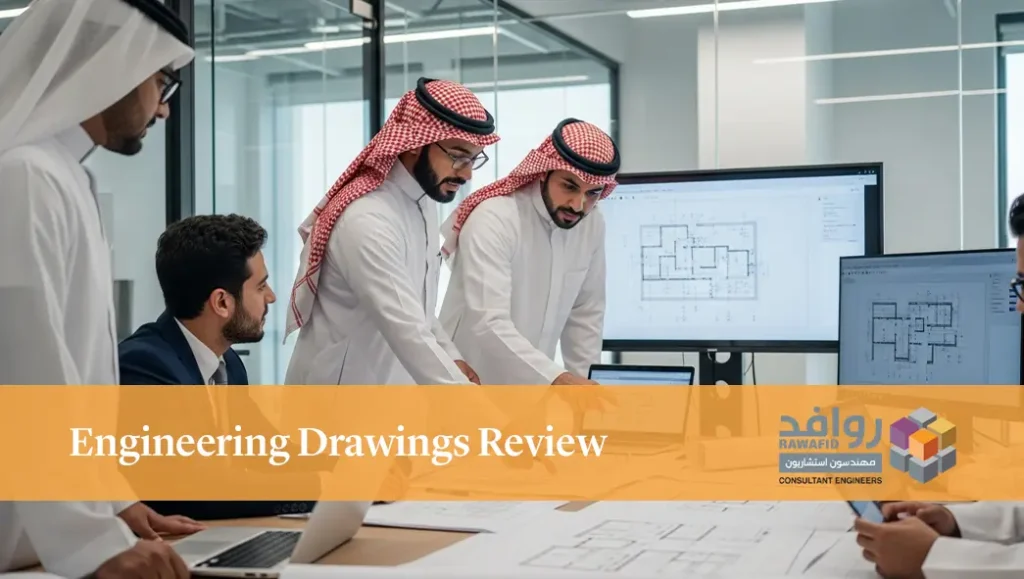
Did You Know That One Poorly Considered Design Error Could Cost You Thousands During Construction?
Have you ever considered that a single overlooked mistake in engineering drawings could lead to thousands of riyals in additional costs during execution?
In many projects, the issue is not poor construction quality, but designs that were not thoroughly reviewed before approval. Coordination conflicts between disciplines, non-buildable details, or specifications that do not align with on-site realities all begin on paper and later turn into costly decisions in the field.
In Saudi Arabia, with stricter regulations and multiple regulatory authorities, approving drawings without in-depth review is no longer a safe step. This is where engineering drawings review becomes a critical phase—transforming designs from static drawings into a clear execution plan, while giving project owners real control over risks, costs, and decision quality before construction officially begins.
What Is Engineering Drawings Review? And Why Is It a Critical Phase?
Engineering drawings review refers to a structured technical process aimed at analyzing drawings and designs prior to execution to ensure compliance with functional requirements, approved regulations, and safety and quality standards.
This process goes beyond identifying visible errors; it examines coordination between various disciplines such as architectural, structural, mechanical, and electrical systems, ensuring they operate within one integrated framework.
This stage also represents a key control point in engineering project planning, as it precedes any financial or contractual commitments. Any decision made without proper review may later translate into additional costs or time delays that are difficult to recover.
Why Is Approving Drawings Without Specialized Review Not Enough?
Many project owners assume that approved drawings are automatically ready for execution. However, practical experience shows this assumption is not always accurate. Administrative approval does not necessarily mean the design is free from clashes or execution-related issues.
The absence of engineering drawings review may result in:
System conflicts on site
Execution difficulties or the need for temporary solutions
Frequent change orders that increase costs
Schedule delays
Disputes between owners and contractors
For this reason, pre-review has become a preventive tool that provides greater project stability and turns drawings into a clear, executable plan.
Engineering Drawings and Specifications Audit: The Technical Depth That Makes the Difference
Drawings auditing represents a deeper and more detailed stage within the review process, where every design element is examined and compared against approved engineering specifications.
At this stage, the focus is not on the general appearance but on precise details that directly affect on-site execution.
Auditing typically includes:
Matching drawings with written specifications clause by clause
Ensuring clarity of execution details and eliminating ambiguity
Reviewing proposed materials and their suitability for the project and environment
Identifying conflicts between architectural, structural, and MEP drawings
This level of scrutiny minimizes surprises during execution and provides all parties with a clear reference, directly improving project quality and reducing waste.
Design Stages and the Importance of Review at Each Phase
Projects pass through several stages, starting with conceptual design, followed by developed design, and finally construction drawings. Each stage serves a different purpose, and any flaw in early stages can escalate later.
When engineering drawings review is integrated into every design phase, it helps to:
Test solutions before final approval
Reduce late and costly modifications
Improve cost estimation accuracy
Facilitate coordination among all disciplines
In professional engineering project planning, design is not viewed as a standalone phase, but as a continuous process that requires review and refinement to keep the project on the right track from the beginning.
How Does Engineering Drawings Review Reduce Site Risks?
Review plays a direct role in reducing construction risks, as most site issues stem from poorly considered design decisions. When these problems are identified during review, they can be resolved on paper rather than on-site at a much higher cost.
Practical benefits include:
Smoother execution
Reduced rework
Greater clarity for execution teams
Fewer unexpected stoppages
For this reason, well-managed projects rely on review as a core element of their risk management system.
The Difference Between an Engineering Office and a Consultancy Office in Drawings Review
An engineering office typically focuses on preparing drawings or executing specific tasks, while a consultancy office takes on a broader role that includes analysis, review, and independent technical evaluation.
A consultancy office does not merely look at drawings during engineering drawings review—it assesses risks, audits details, and ensures compliance with regulations and specifications.
This distinction is especially important in medium and large projects in Saudi Arabia, where engineering decision quality is a decisive factor in project success or failure.
How to Choose the Right Entity for Engineering Drawings Review in Saudi Arabia?
Selecting the entity responsible for review is not a secondary decision—it is a strategic step that impacts the entire project. The right entity combines technical expertise, local market knowledge, and a clear methodology.
When making your choice, ensure the entity:
Is officially licensed and accredited
Has experience in engineering project planning
Follows a clear drawings audit methodology
Understands Saudi codes and engineering specifications
Provides clear, actionable reports
Making the right choice at this stage saves significant effort and cost later on.
Frequently Asked Questions
Is engineering drawings review necessary for all projects?
Yes, while complexity varies, the benefits apply to all projects.
Can review be sufficient without detailed auditing?
Auditing provides a higher level of safety, especially for complex projects.
Does review affect execution speed?
On the contrary, it reduces stoppages and accelerates execution.
Does review cover regulatory aspects only?
No, it includes technical, execution, and regulatory aspects together.
Conclusion | Looking for an Engineering Review That Protects Your Investment?
At Rawafed, we believe that every successful project starts with the right engineering decision at the design stage.
We provide professional engineering drawings review services through a structured methodology that includes engineering project planning, drawings auditing, and engineering specifications analysis—all in compliance with approved Saudi regulations.
Contact Rawafed today and let our team help you turn your drawings from a source of risk into a solid foundation for a successful and stable project.