
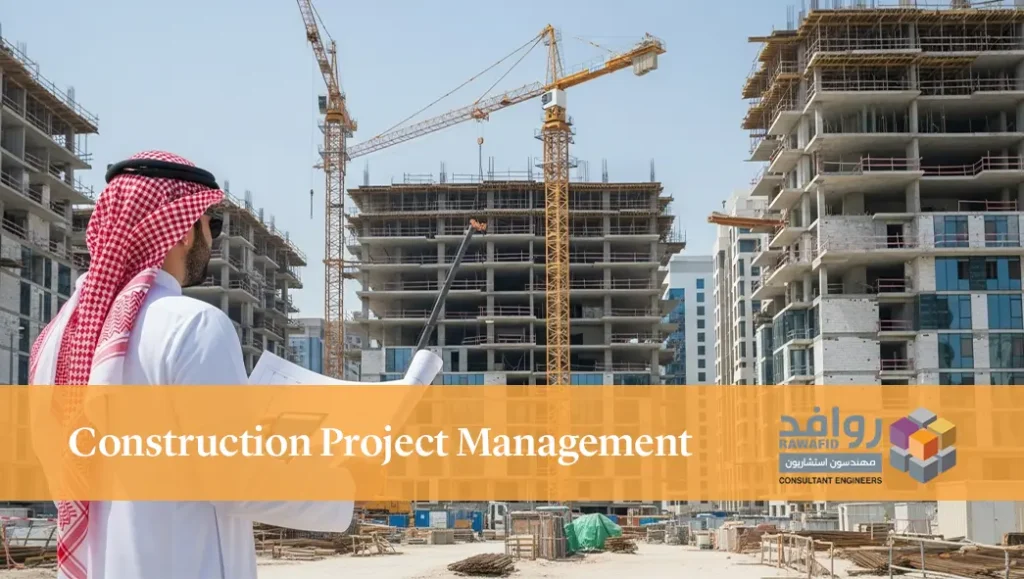
Did you know that a large percentage of stalled construction projects are not caused by budget shortages or poor execution, but by poor construction project management from the very beginning?
In many projects across Saudi Arabia, things start off well, then delays appear, costs increase, and quality declines—not because the idea is wrong, but because project management was not at the required level.
In a contracting market characterized by intense competition and strict regulatory requirements, project management is no longer just about following a timeline. It has become a decisive factor in protecting investments and ensuring project success. In this guide, we take you through the topic from a practical perspective and explain how proper management impacts time, cost, and quality, and what project owners should pay attention to before and during execution.
The Concept of Construction Project Management and Its Importance in the Saudi Market
Construction project management refers to the integrated process through which a construction project is planned, organized, executed, and controlled in order to achieve defined objectives within the allocated budget, timeline, and required quality. This management is not limited to the technical aspect only; it also includes coordination between different stakeholders, resource management, risk monitoring, and timely decision-making.
In the Saudi market specifically, the importance of project management increases due to:
The scale of projects and the number of involved parties
Strict compliance with the Saudi Building Code and regulations
The high cost of errors and delays
Expansion in residential, commercial, and infrastructure projects
Effective project management means having a clear vision from day one, precise role distribution, and a realistic execution plan. In contrast, the absence of proper management often leads to conflicting decisions, weak oversight, and delayed delivery. For this reason, project management has become a core element no less important than design or execution itself.
Key Roles and Responsibilities in Construction Project Management
The success of any contracting project depends directly on the clarity of roles within the management framework. Project management is not the responsibility of a single individual, but an integrated system led by the project manager and supported by multiple parties.
Key roles include:
Project Manager: Responsible for overall planning, execution follow-up, time and cost control, and risk management
Supervising Engineer: Ensures execution complies with approved drawings and specifications
Cost Management: Monitors spending and analyzes financial deviations
Procurement and Contract Management: Handles contracts and material supply
Quality and Safety Management: Ensures work is carried out according to approved standards
Lack of coordination among these roles leads to conflicting decisions and execution issues. Therefore, successful construction project management relies on clear responsibilities, a defined authority structure, and effective communication mechanisms among all parties.
Construction Project Management Steps from Planning to Handover
Project management goes through several interconnected stages, each directly affecting the next. The process begins long before construction starts—not when work begins on site. Effective management does not only mean executing these stages, but linking them smoothly and making early decisions that prevent the accumulation of problems. The clearer the steps are from the beginning, the higher the chances of delivering the project on time and within budget.
Key stages include:
Planning Phase: Defining project scope, budget, schedule, and risk expectations
Preparation Phase: Contract preparation, drawing approvals, and schedule coordination
Execution Phase: Daily work monitoring, quality control, and change management
Control Phase: Comparing actual performance with the plan and correcting deviations
Handover Phase: Ensuring completion of works, project handover, and contract closure
Construction Project Management Software and Its Role in Performance Improvement
With the increasing complexity of modern projects, relying on manual tracking is no longer sufficient. This is where project management software becomes an essential tool for controlling projects.
These programs help with:
Creating schedules and tracking progress
Managing resources and workforce
Monitoring costs and deviations
Improving communication between teams
Documenting decisions and changes
Using the right software does not only save time—it also reduces human error and gives the project manager a comprehensive view of the project status at any time. However, the success of these tools still depends on having a team that knows how to use them within a proper construction project management framework, not as a standalone technical solution.
Challenges of Construction Project Management in Building Projects
Despite its importance, construction project management faces many challenges that can hinder execution if not handled properly. Addressing these challenges requires proactive planning, effective risk management, and the presence of a specialized entity capable of making informed decisions at the right time.
Key challenges include:
Design changes during execution
Poor coordination between stakeholders
Delayed procurement or material shortages
Unplanned cost increases
Shortage of qualified personnel
The Relationship Between Project Management and Execution Quality
Construction project management directly impacts the final quality of the project. Quality is not the result of a single stage, but the outcome of correct management decisions from planning through handover.
Good management ensures:
Selection of materials that meet specifications
Execution according to approved drawings
Early-stage inspection of works
Prevention of accumulated construction errors
On the other hand, poor management leads to temporary solutions and quality compromises to catch up with schedules, which negatively affects the building’s lifespan and future maintenance costs.
How to Choose a Specialized Construction Project Management Firm
Choosing the entity responsible for project management is a strategic decision no less important than selecting the contractor. The right firm must have practical experience, a deep understanding of the local market, and thorough knowledge of Saudi regulations.
When selecting, consider the following:
Previous experience in similar projects
Ability to manage time and cost
Clear work methodology
Compliance with the Saudi Building Code
Strength and specialization of the team
Having a professional firm like Rawafed managing construction projects gives you greater peace of mind and transforms the project from a source of stress into a structured, controllable process.
Frequently Asked Questions
Can a project be managed without a specialized project manager?
It is possible for small projects, but it significantly increases risks in medium and large projects.
Does construction project management really reduce costs?
Yes, because it minimizes waste, prevents costly errors, and supports accurate financial decisions.
What is the difference between contractor management and project management?
The contractor executes the work, while project management oversees, coordinates, and controls overall performance.
Does construction management vary depending on project type?
Yes, it varies based on project size, nature, and the number of involved parties.
Conclusion | Are You Looking for Project Management That Protects Your Investment?
At Rawafed, we provide professional construction project management services using a well-studied methodology aligned with the Saudi market and approved codes—ensuring high-quality execution and on-time delivery.
Contact Rawafed today and let our team support you from the first step to final handover with confidence and peace of mind.