
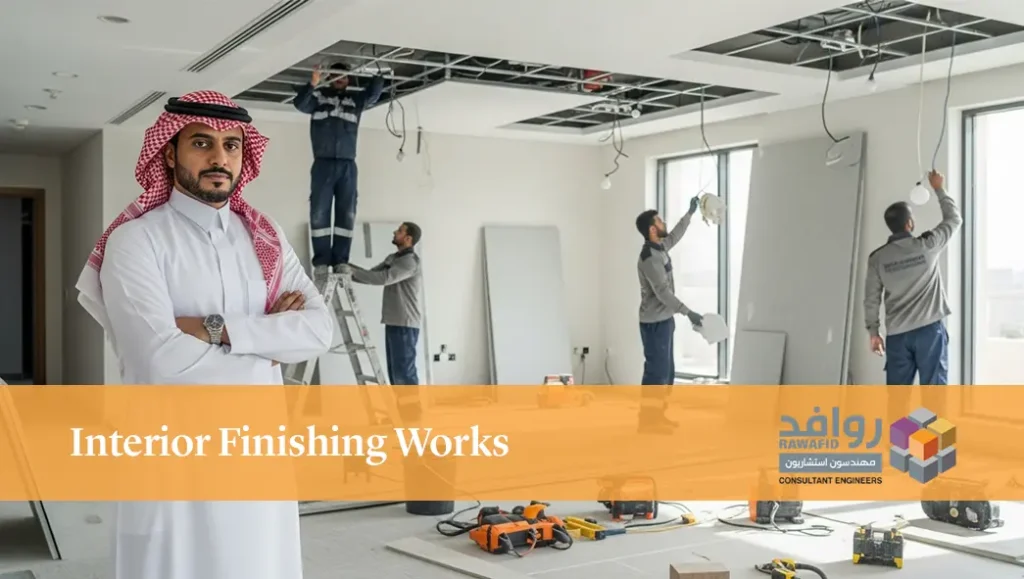
Interior Finishing Works: Execution Stages and Common Mistakes
Did you know that many problems in residential or office projects don’t appear upon handover, but months after occupancy? Cracks, paint defects, lighting issues, or flooring problems… Often, the cause is not the materials themselves but the way interior finishing works were executed from the start.
In the Saudi market, with rising construction costs and increasing owner and investor expectations, finishes are no longer just an aesthetic stage—they are a critical element in project quality and long-term value. This practical guide takes you step by step to understand the concept of interior finishes, their stages, types, and key factors that ensure professional execution without surprises.
Concept of Interior Finishing Works and Scope
Interior finishing works refer to all activities carried out inside a building after completing the structural framework, aimed at transforming spaces into functional and visually appealing areas. It is not limited to paint or flooring but includes a comprehensive set of technical and engineering tasks.
The scope usually includes:
Plastering and wall finishes.
Flooring of all types.
Suspended and gypsum ceilings.
Painting and final finishes.
Electrical works and lighting.
Plumbing works.
Doors, windows, and accessories.
In Saudi projects, this stage has additional importance due to climate considerations, Saudi building codes, and varied building uses. Any flaws at this stage can lead to high future maintenance costs. Understanding the scope of interior finishes from the start helps owners make the right decisions, control the budget, and define the required quality level accurately.
Execution Stages of Interior Finishing Works
The stages of execution are among the most critical factors in project success, as any unorganized or non-sequential execution can lead to rework, increased costs, and wasted time.
Typical stages include:
Planning and preparation: Reviewing plans, selecting materials, and determining the budget.
Foundational works: Electrical and plumbing installations before closures.
Plastering and ceiling works: Preparing walls and ceilings for the final finish.
Flooring and coverings: Installing tiles, wood, or other materials.
Painting and final finishes: Achieving the final aesthetic appearance.
Final installations and inspection: Lighting, sanitary fixtures, and system testing.
Adhering to the correct technical sequence ensures higher execution quality and reduces errors that may appear later. In the Saudi market, with multiple teams and overlapping tasks on-site, systematic management of these stages is essential to meet the timeline and achieve high-quality, sustainable interior finishes.
Types and Levels of Interior Finishes
The types of finishes vary according to budget, usage, and owner requirements. Choosing the right type affects not only aesthetics but also building longevity and market value. Each type has specific material requirements, execution time, and level of supervision.
Common levels include:
Economic finish: Suitable for temporary or investment projects, focusing on functionality over detail.
Medium finish: Balanced between quality and cost; common in residential units.
Luxury finish: High-quality materials and meticulous details; often used in villas and premium projects.
In Saudi Arabia, many owners prefer medium or luxury finishes due to their direct impact on comfort and property value.
Choosing Interior Finishing Materials
Selecting materials is a critical step in finishing success. Even the best design may fail if unsuitable materials are used for the environment or purpose. For example, flooring materials suitable for kitchens differ from those for bedrooms, and office requirements differ from residential units. Smart material selection reduces future defects, enhances finish quality, and gives the project a professional, long-lasting appearance.
Key factors to consider include:
Moisture and heat resistance.
Ease of maintenance and cleaning.
Durability and lifespan.
Suitability for intended use.
Compliance with specifications and Saudi building codes.
Common Mistakes to Avoid
Despite clear steps, many projects face repeated mistakes during finishing. These issues often do not appear immediately but affect long-term project quality.
Most common mistakes include:
Starting execution without detailed plans.
Changing decisions during execution.
Choosing materials based on price only.
Lack of engineering supervision.
Prioritizing schedule over quality.
Avoiding these mistakes requires prior planning and a qualified entity supervising interior works from start to handover, as correcting errors after execution is usually more expensive than getting it right the first time.
Importance of Engineering Supervision
Engineering supervision is the true guarantee of finishing quality. Having an engineer or specialized office overseeing execution ensures adherence to plans, specifications, and the correct work sequence.
Supervision helps to:
Detect errors early.
Ensure quality of materials and execution.
Coordinate different work teams.
Reduce waste and delays.
Deliver the project without major issues.
In Saudi projects, where requirements and regulations are numerous, supervision is essential for executing interior finishes according to the highest standards.
Choosing a Reliable Contractor for Interior Finishes
Selecting the right contractor is not merely a procedural step but an investment decision determining the finish quality and long-term comfort for the owner. A professional entity does not only execute but also provides expertise in planning, choosing optimal solutions, and managing details from the start.
With a specialized company like Rawafed, interior works turn from a stressful and experimental phase into a structured, clear process managed professionally, ensuring quality execution, timely delivery, and the best project value.
Key selection criteria:
Proven prior experience.
Understanding of the Saudi market.
Clear contracts and commitments.
Engineering supervision.
Commitment to quality and deadlines.
FAQ
Can interior finishing be executed in stages according to the budget?
Yes, provided there is prior planning to ensure later work quality is not affected.
How long does interior finishing usually take?
It varies by project size and type of finish, typically ranging from several weeks to a few months.
Do interior finishes require permits?
In some cases, especially for modifications, compliance with local authorities is required.
Is engineering supervision necessary for small projects?
Even for small projects, supervision reduces errors and ensures higher quality.
Conclusion | Do You Want Interior Finishes Without Surprises?
At Rawafed, we provide professional interior finishing solutions based on careful planning, supervision, and deep understanding of the Saudi market. We accompany you from concept to handover to ensure lasting quality and true project value.
Contact Rawafed today and let our team implement smart finishes worthy of your project.