
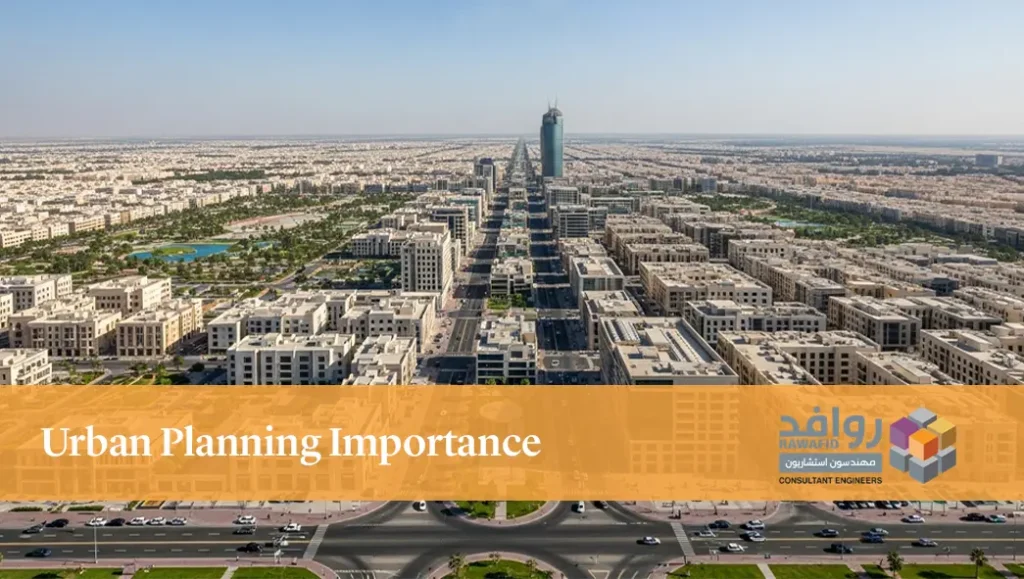
Have You Ever Wondered Why Some Cities Manage Population Growth Smoothly While Others Struggle?
Have you ever wondered why some cities successfully accommodate population growth with ease, while others suffer from congestion, weak services, and declining quality of life?
In most cases, the issue is not a lack of resources, but rather the absence of a clear planning vision from the start. This is where urban planning emerges as a decisive factor in shaping the future of cities and projects—not merely as a secondary regulatory procedure.
In Saudi Arabia, with rapid urban expansion and large-scale developments, urban planning has become a strategic tool to ensure optimal land use, enhance infrastructure efficiency, and achieve balance between development and community needs.
In this article, we provide a practical guide explaining the concept, tasks, importance, and challenges of urban planning, while linking it directly to project success and quality of life.
Definition of Urban Planning and Its Fundamentals in Modern Development
Urban planning refers to the process of organizing and guiding land use and resources within cities and urban areas to achieve balanced development that meets present needs without compromising the ability of future generations. It goes beyond drawing layouts to include a comprehensive vision of how a city grows and how its functions are distributed.
The importance of urban planning lies in the fact that it forms the foundation for all subsequent urban decisions, such as residential locations, business districts, road networks, and public facilities.
In the Saudi context, urban planning gains additional significance due to rapid growth, diverse projects, and strict compliance with approved regulations and building codes. The absence of clear planning often leads to unregulated expansion, pressure on services, and increased corrective costs later on. Therefore, successful urban development cannot be achieved without a true understanding of urban planning fundamentals and their pivotal role.
Urban Planning Tasks and Its Role in Organizing City Growth
These tasks include a set of measures aimed at organizing city growth in a balanced and well-considered manner, away from randomness and short-term reactions.
Key urban planning tasks include:
Regulating land use and defining suitable activities for each zone.
Distributing services and facilities fairly.
Guiding urban expansion in line with infrastructure capacity.
Protecting environmental areas and sensitive sites.
Supporting economic and social development.
These tasks play a direct role in reducing future challenges such as traffic congestion or service shortages. They also help authorities and investors make decisions based on a clear long-term vision rather than temporary solutions.
Cities that rely on effective planning experience more stable growth, where projects form part of an integrated system rather than isolated elements. This highlights urban planning as both a regulatory and strategic tool.
The Importance of Urban Planning for Cities and Improving Quality of Life
The answer lies in its direct impact on residents’ daily lives and overall city efficiency. The better a city is planned, the more capable it becomes of accommodating growth without negatively affecting quality of life. Urban planning influences not only the city’s appearance, but also health, comfort, and social connections within the community.
Effective urban planning contributes to:
Reducing traffic congestion.
Improving access to services.
Providing public spaces and parks.
Creating a safe and healthy environment for residents.
In Saudi Arabia, with increasing demand for housing and services, urban planning is closely linked to quality of life goals aligned with Vision 2030. Well-planned cities are more attractive to residents and investors and better positioned for sustainable growth.
The Role of Site Analysis in Effective Urban Planning
Site analysis is one of the most critical stages of urban planning, as it forms the basis for all subsequent decisions. Any deficiency at this stage may negatively impact the entire project or area.
In Saudi projects, site analysis is essential to align urban planning with local regulatory requirements, enhancing long-term project success.
Site analysis includes studying:
Geographic and environmental location.
Existing infrastructure.
Soil conditions and climate.
Surrounding activities.
Current and future population needs.
Through proper analysis, optimal land use can be identified, risks reduced, and harmony achieved between the project and its surroundings. It also improves design efficiency and minimizes execution-stage modifications.
The Importance of Urban Planning in the Success of Real Estate and Construction Projects
Urban planning is not limited to cities; it also extends to individual projects. There is a direct relationship between urban planning and project success—whether residential, commercial, or mixed-use.
Projects developed within a clear planning framework are more sustainable and less prone to future challenges. In contrast, projects that ignore urban planning may achieve short-term success but often face long-term difficulties.
Good planning helps to:
Select the appropriate project location.
Define optimal density and land use.
Reduce operational risks.
Increase market value.
Facilitate regulatory approvals.
For this reason, urban planning has become a core factor in investment and development decisions in Saudi Arabia, not merely a procedural step.
Challenges Facing Urban Planning in Modern Cities
Despite its importance, implementing urban planning faces several challenges in modern cities, especially amid rapid growth. Addressing these challenges requires flexible, data-driven planning capable of adapting to change, as well as specialized advisory entities with local expertise and future-oriented vision.
Key challenges include:
Rapid population growth.
Uncontrolled urban expansion.
Weak coordination between stakeholders.
Changing needs over time.
Regulatory and implementation constraints.
Urban Planning in Saudi Arabia: Present and Future
Urban planning in Saudi Arabia is witnessing significant development driven by Vision 2030 and major national projects. Planning is no longer limited to land regulation; it has become a tool for comprehensive and sustainable development.
Modern regulations, municipal requirements, and the shift toward smart cities reflect a growing awareness of urban planning’s role in shaping a balanced urban future. However, success remains dependent on study quality, execution efficiency, and integration among various stakeholders.
Frequently Asked Questions
Is urban planning limited to new cities only?
No, it can also be applied to the redevelopment of existing areas and the treatment of long-standing urban issues.
What is the difference between urban planning and urban design?
Urban planning defines the overall framework, while urban design focuses on physical details and public spaces.
Does urban planning increase project costs?
In the short term, it may require higher investment, but it reduces future costs and risks.
Who is responsible for preparing urban planning?
It is typically carried out by government entities in collaboration with specialized consulting offices.
Conclusion | Are You Planning a Successful Urban Development Project?
At Rawafid, we provide urban planning services and specialized studies built on a deep understanding of the Saudi market and approved regulations—helping you make informed decisions from the very beginning.
Contact Rawafid today, and let our team support you in building a successful and sustainable project with clear vision and complete confidence.